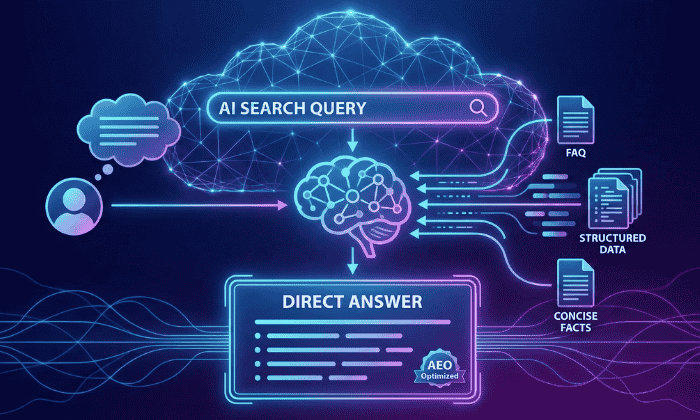
What Is Answer Engine Optimization (AEO)?
Answer Engine Optimization (AEO) is the process of optimizing your content so AI-powered systems — like ChatGPT, Google’s AI Overviews, Perplexity, Gemini, and other answer engines — can understand, extract, and present your information directly as answers.
Traditional SEO focuses on ranking websites in search results.
AEO focuses on ranking your content inside AI-generated answers.
Examples of answer engines include:
- Google AI Overviews
- ChatGPT Search
- Perplexity
- Claude Search
- Bing Deep Search
These platforms no longer rely only on links. Instead, they use:
- Knowledge graphs
- Semantic search
- Structured data
- Entity understanding
- Natural language patterns
This shift means: If your content is not machine-readable and entity-focused, you won’t appear in AI answers — even if you rank well in Google.
Why AEO Matters
Users now prefer fast, summarized answers instead of long search journeys.
Answer engines respond to this need by delivering instant, authoritative, context-rich responses.
Brands must adapt because:
- Traffic will reduce for pages that rely only on keyword rankings.
- AI answers often cite only 2–5 sources, not 10 blue links.
- Content that is unclear or unstructured gets ignored by AI models.
AEO helps your site become part of these answer sources.
How Answer Engines Work
Answer engines work differently from traditional search engines.
They prioritize meaning over keywords.
They use:
Entity Recognition
Instead of keywords, answer engines understand:
- People
- Places
- Services
- Products
- Brands
- Concepts
When your content defines entities clearly, answer engines trust it more.
Semantic Search
Answer engines analyze:
- Context
- Intent
- Topic relationships
- Question-answer patterns
This means simply stuffing keywords doesn’t help.
Clear explanations do.
Structured Data & Schema
Schemas help machines interpret your content.
Answer engines heavily rely on structured data to verify facts.
Useful schema types for AEO include:
- FAQ
- HowTo
- Product
- Organization
- Article
- LocalBusiness
- Breadcrumb
Source Trustworthiness
AI models favor sources that:
- Publish original content
- Have clear authorship
- Maintain topic authority
- Provide well-cited information
Trust signals help models decide whether to include your site in answer snippets.
AEO Best Practices (That Actually Work)
Write Clear, Direct Answers
Each question should have a short, clear answer within the first 1–2 sentences.
For example:
Q: What is Answer Engine Optimization?
AEO is the process of optimizing your content so AI systems can understand and use it inside generated answers.
This makes your content “answer-friendly.”
Use Structured Data for Every Important Page
FAQ schema and HowTo schema significantly increase inclusion in AI-generated responses.
Example pages that NEED schema:
- Service pages
- FAQ pages
- How-to guides
- Product descriptions
- Local business info pages
Build Topic Authority (Deep Content Clusters)
Answer engines prefer expert-level content.
Create multiple related articles around one theme.
This builds strong entity relationships across your site.
Example AEO cluster:
- What Is AEO?
- How Answer Engines Work
- AEO vs Traditional SEO
- How to Structure Content for AI Answers
- How Schema Helps AEO
- AEO Tools & Techniques
Optimize for Conversational Queries
AI engines mimic human language.
Your content must reflect how humans ask questions.
Examples:
- “How do I…?”
- “What is the best way to…?”
- “Why does… happen?”
Answer these directly.
Improve E-E-A-T Signals
Clear author bios, credentials, and citations help answer engines trust your content.
Important elements:
- Author pages
- LinkedIn profiles
- Cited sources
- Dates of updates
- References at the bottom
Publish Long-Form, Well-Structured Content
AI models scan entire pages, not just sections.
Use:
- H2/H3 headings
- Short paragraphs
- Clear definitions
- Examples
- Lists
- Tables
This helps models extract answers correctly.
Use Entities, Not Just Keywords
Instead of focusing on exact-match keywords, include related entities.
Example for AEO:
- “AI search systems”
- “semantic search”
- “LLM answer engines”
- “structured data”
- “knowledge graphs”
- “machine-readable content”
This builds machine-friendly context.
What AEO Means for the Future of SEO
SEO is shifting from “rankings” to “visibility inside AI answers.”
AEO helps you:
- Get mentioned or cited by AI systems
- Become a trusted source for answer engines
- Capture traffic even when search engines change
- Build long-term content authority
Websites that embrace AEO early will dominate the new search era.
Read, Learn Local SEO Guide to Ranking Higher in Local Search