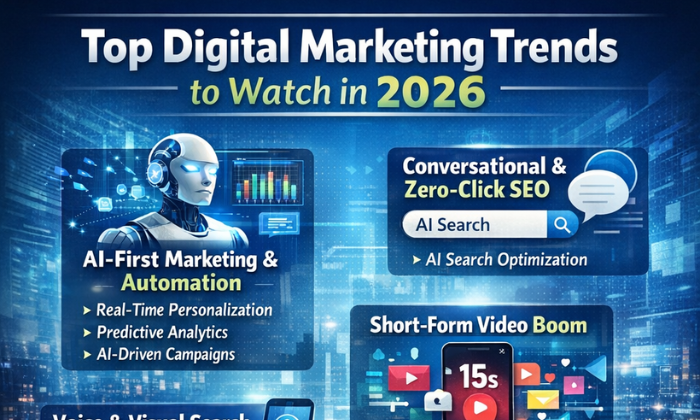
Top Digital Marketing Trends to Watch in 2026
Digital marketing is evolving faster than ever. New technologies, changing consumer behavior, and stricter data regulations are transforming how businesses connect with their audiences online. What worked in 2023 or 2024 is no longer enough to stay competitive in 2026.
Today’s customers expect personalization, transparency, speed, and authentic brand experiences. At the same time, businesses must adapt to AI-driven tools, privacy regulations, and emerging content formats. Companies that fail to adjust risk falling behind their competitors.
If you want your brand to grow, attract quality leads, and build long-term trust, understanding the top digital marketing trends in 2026 is essential.
Let’s explore the key trends shaping the future of digital marketing this year.
AI-Powered Personalization and Automation
Artificial intelligence is no longer optional in digital marketing. In 2026, AI is at the center of campaign planning, execution, and optimization.
AI tools analyze massive amounts of customer data in real time. They identify patterns in behavior, interests, browsing habits, and purchasing decisions. This allows businesses to deliver highly personalized experiences at scale.
For example, AI can:
-
Recommend products based on previous browsing history
-
Send personalized email campaigns triggered by user actions
-
Optimize ad targeting automatically
-
Predict which leads are most likely to convert
Chatbots powered by AI are also becoming more advanced. They now provide instant responses, guide customers through buying decisions, and offer 24/7 support without human intervention.
Automation combined with AI reduces manual work and improves performance. Businesses that leverage AI effectively will see higher engagement rates, better conversions, and stronger customer loyalty.
Voice Search Optimization
Voice search continues to grow rapidly as smart speakers, smartphones, and voice assistants become part of daily life. Users now search using natural, conversational phrases instead of short keywords.
For example, instead of typing:
“best SEO tools”
Users might say:
“What are the best SEO tools for small businesses in 2026?”
This shift requires marketers to optimize for long-tail keywords and question-based queries. Content must be clear, direct, and structured in a way that answers specific user questions.
To prepare for voice search in 2026:
-
Focus on conversational content
-
Optimize for featured snippets
-
Use FAQ sections
-
Target long-tail keyword phrases
Voice search is especially important for local businesses, as many users search for nearby services using voice commands.
Short-Form Video Dominance
Video marketing remains one of the most powerful tools in digital marketing. However, short-form video is leading the trend in 2026.
Videos under 60 seconds perform exceptionally well because they capture attention quickly. Users prefer fast, engaging, and easy-to-consume content.
Short-form videos help brands:
-
Increase engagement
-
Build brand awareness
-
Reach younger audiences
-
Improve social media visibility
Live video content is also growing. It allows real-time interaction, builds authenticity, and creates a sense of urgency.
Businesses that consistently produce valuable video content will gain stronger audience connections and higher conversion rates.
Privacy-First Marketing and First-Party Data
Data privacy is one of the biggest concerns in digital marketing today. With stricter regulations and increasing consumer awareness, brands must be transparent about how they collect and use data.
Third-party cookies are being phased out, which means businesses need to rely more on first-party data — information collected directly from customers through websites, emails, subscriptions, and surveys.
In 2026, successful brands will:
-
Use clear consent forms
-
Provide transparent privacy policies
-
Build email lists organically
-
Offer value in exchange for user data
Privacy-first marketing builds trust. And trust leads to long-term customer relationships.
Influencer and Creator Economy Expansion
Influencer marketing continues to evolve. In 2026, authenticity matters more than follower count.
Micro-influencers and niche creators often generate higher engagement rates because they have stronger connections with their audiences. Instead of one-time sponsored posts, brands are focusing on long-term collaborations.
Consumers are more likely to trust recommendations from creators they follow regularly.
Brands that prioritize genuine partnerships over promotional campaigns will see better engagement and improved brand credibility.
Interactive and Immersive Marketing Experiences
Consumers no longer want to passively consume content. They want interactive experiences.
Interactive content increases engagement and encourages participation. Examples include:
-
Polls and surveys
-
Quizzes
-
Interactive infographics
-
Augmented reality (AR) filters
-
Virtual product try-ons
Augmented reality is becoming more common in e-commerce. Customers can preview furniture in their homes or try on products virtually before purchasing.
Immersive marketing increases brand recall and makes campaigns more memorable.
Sustainability and Purpose-Driven Marketing
Modern consumers expect brands to stand for something meaningful. Sustainability and social responsibility are influencing buying decisions more than ever.
Customers prefer brands that:
-
Support environmental initiatives
-
Use ethical sourcing practices
-
Promote diversity and inclusion
-
Contribute to community development
However, authenticity is critical. Consumers can quickly identify “greenwashing” or fake social responsibility efforts.
Brands that genuinely commit to sustainable practices and communicate them transparently will build stronger trust and loyalty.
Omnichannel Marketing Strategy
In 2026, customers interact with brands across multiple platforms — websites, social media, email, search engines, and messaging apps.
An effective digital marketing strategy must provide a seamless experience across all channels.
Omnichannel marketing ensures:
-
Consistent messaging
-
Unified brand identity
-
Smooth customer journeys
-
Better data tracking
When customers receive a consistent experience everywhere, they are more likely to trust and engage with the brand.
Search Experience Optimization (SXO)
Traditional SEO is evolving into Search Experience Optimization. Ranking high is important, but user experience is equally critical.
Google prioritizes websites that offer:
-
Fast loading speeds
-
Mobile responsiveness
-
Clear structure
-
Valuable content
-
Strong user engagement
In 2026, businesses must focus not only on keywords but also on improving overall user satisfaction.
Conclusion
Digital marketing in 2026 is defined by intelligence, personalization, privacy, and authenticity. Technology continues to advance, but building genuine customer relationships remains the core objective.
Brands that adopt AI-driven strategies, optimize for voice search, create engaging video content, prioritize privacy, collaborate with creators, and embrace immersive experiences will stay ahead of the competition.
The future belongs to businesses that combine innovation with trust.
Now is the time to adapt, experiment, and lead.